
Brightly Coloured Pollen, Pickled Rhubarb and the Potential for Mischief
Beekeeping, pickling and eating warm cake.

“Before achieving a dream, you need to make very little steps... People don’t understand that when you want to make a big dream, you have a lot of fastidious little things you have to do.”
Bertrand Piccard
West Berkshire, March 2026
Once again with my writing schedule completely on its head, here I am.
I hope you enjoy. It was a pleasure to write it for you.
Textures
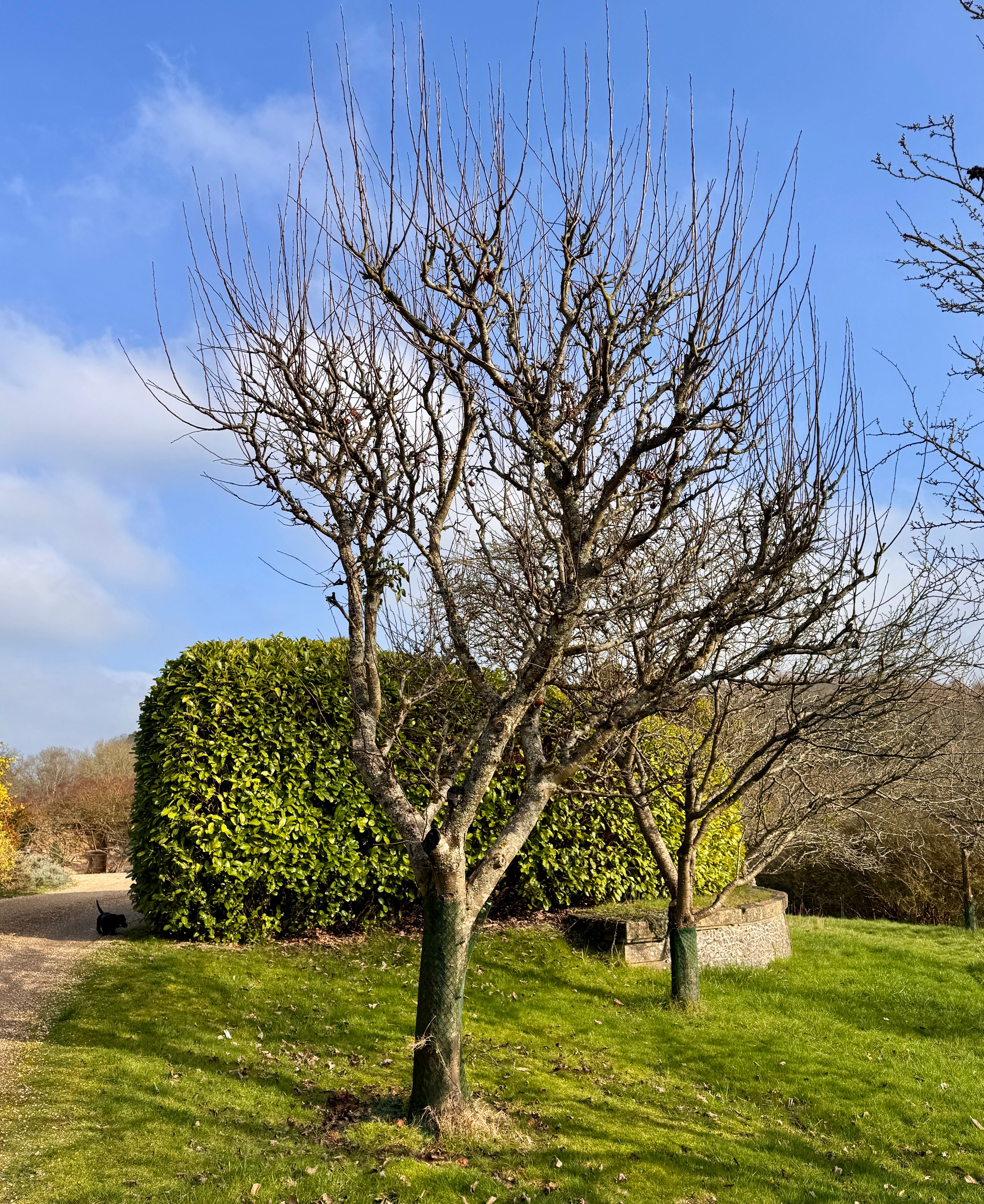
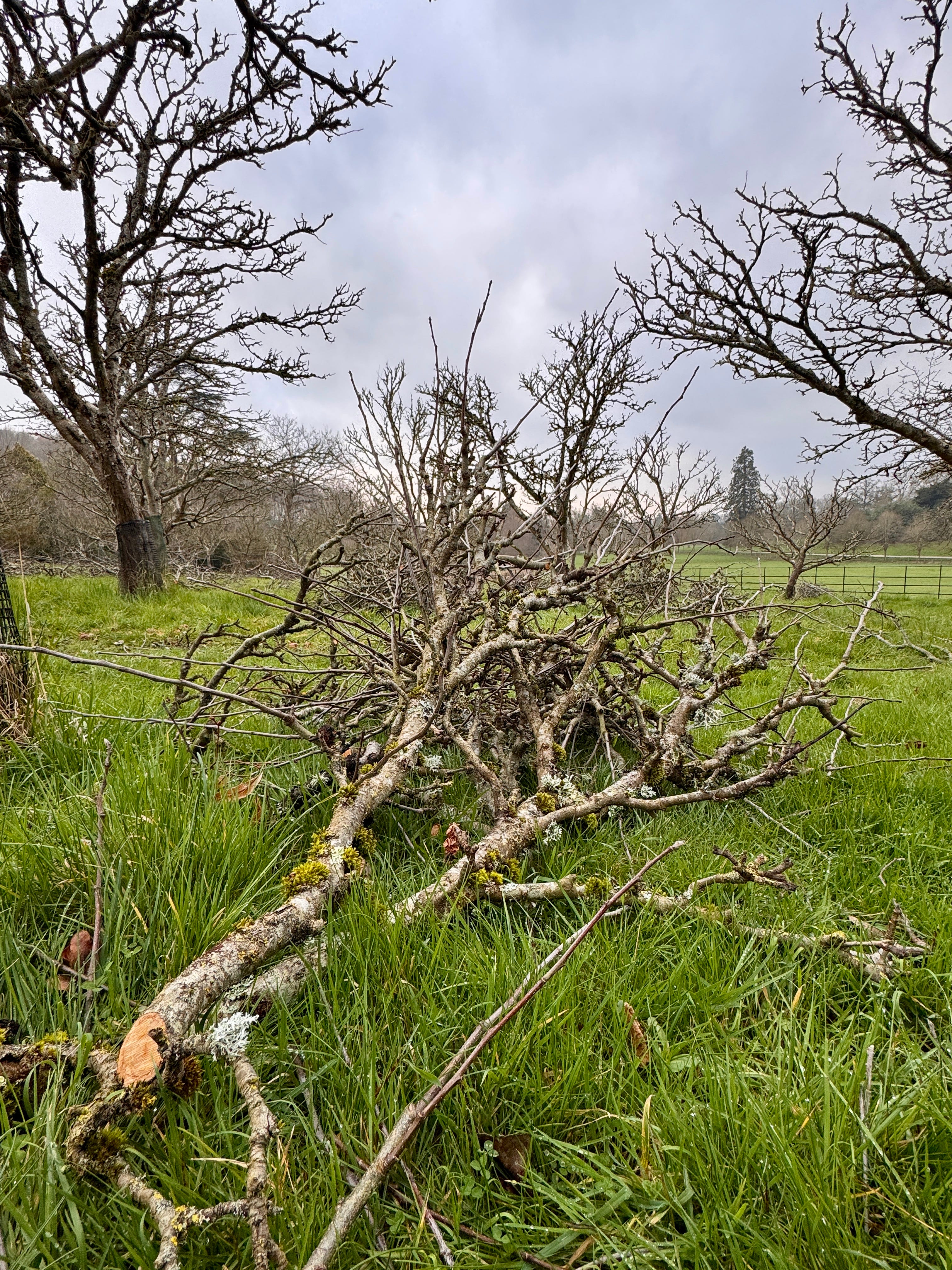
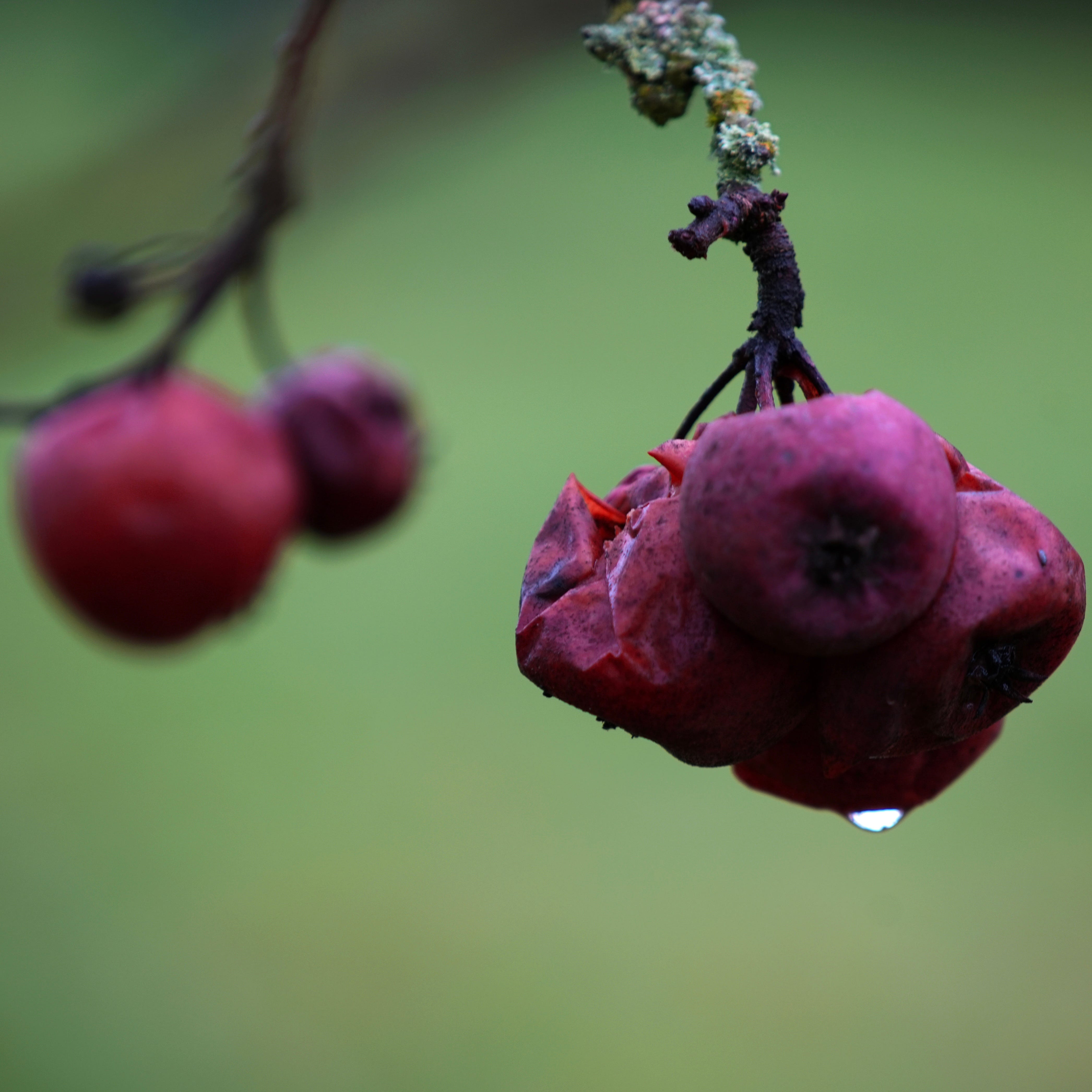
Twisted and gnarled stands a lofty, silent Newton’s Wonder in the far corner of the orchard near the old stone wall where the Norwegian Forest cats like to wait for mice to pounce on. Lichen, blue and green scaly plates and soft fuzzy moss cover the smooth York stones, laid here by hand with rough mortar over two centuries ago. Looking up, a handful of shrivelled fruits still hang, decaying from their high branches, buds on limbs still tightly closed for winter despite the recent sun, and unlike the blossom trees that showed promise weeks ago as they burst into life, the apple and pear trees stay quiet for now. Piles of neat prunings piled into tangled heaps underneath, carefully sawn by hand and heaped neatly below each tree, each deep cut a considered action, a judgment, based on years of knowledge by a man who is a walking encyclopedia on pips and stonefruit.
Off the lane and into the woodland, Blackthorn, Cherry, Wild Plum, Sallow and branches of Rowan buds line the muddy tracks that wind their way through the unmown fields here threaded amongst the boundary lines of twisted bracken, decayed rose hips and the woven threads of last year’s brambles. The early blossom, a patchwork of muted pinks and brilliant whites, speckled with bright pollen, all in early bloom amongst the long, sharp thorns and grey bark of this hushed backdrop.
Milk thistle grows in clumps under the yew, paint splashed flecks of brilliant white against the deeply green, spiny, structured points of the coarse leaves that prick your fingers if you try to handle them, whilst the last of the old, bruised rose hips that the birds have left to shrivel and stain, still hang amongst the quicksets.
The skull of a deer sits wedged deep in a thicket of hazel branches, an unfortunate end for an inquisitive Roe likely a decade ago, as only the bare, ivory curved bone remains, dusted with scales of lichen and moss, whilst the silence of the wind and the screech of the Buzzards hunting high above are all I can hear.
Spring pollen
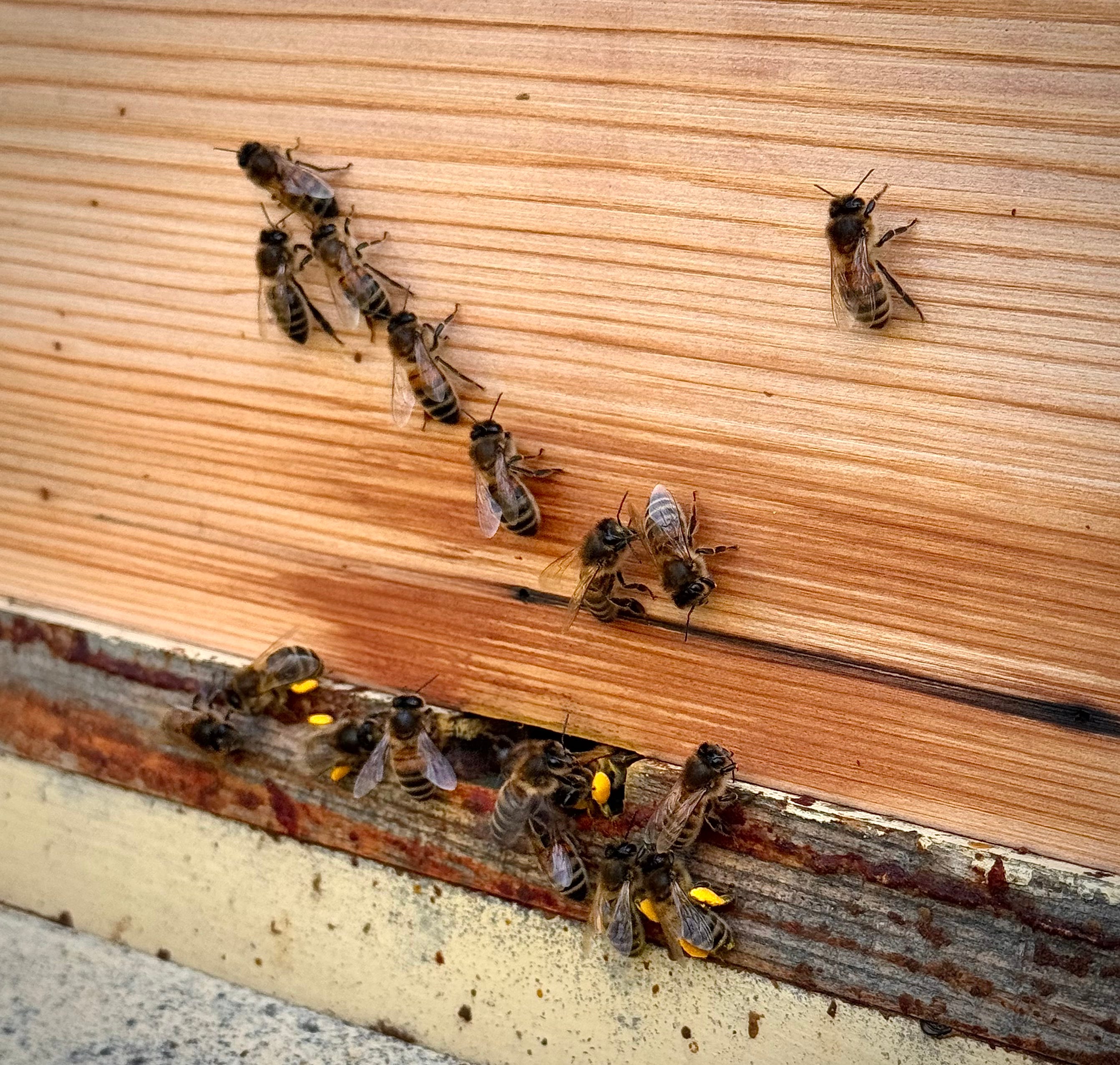
Crocus, primrose, hazel and yew, with the last of the snowdrops, give good reason for the bees to be flying in colder temperatures. This early hunt for pollen gives me cause to be hopeful for the approach of the beekeeping season. I had clad the outside of the cedar hive with thick insulation in mid December, just as two weeks of dismal, freezing weather arrived. As ugly as the cobbled together assembly of foam panels looked, all held together, bound with stout tape in the middle of a freezing rainstorm in the early new year, anchored in place with old mossy bricks I’d gathered, that had fallen years ago from the tumbled down cemetery wall. It sealed any potential gaps between the stacks of hive boxes from the chill winds that blow across these fields. Fastidious creatures that they are, if one tiny crack had been left unsealed with the sticky propolis that they use to glue their world together, then a spike of cold air would have been enough to chill these girls with a very real risk of colony collapse, so as unaesthetic as the apiary looked over winter, the plumes of bees flying in and out of their hive today, chunks of pollen, bright yellow, amber and golden, stuck to their legs tells me that there is incentive enough for them to forage and their unsightly winter set up had worked
Their Queen, hidden deep inside these boxes, has likely committed to laying, and the pollen is needed to feed her brood. At the end of last autumn, I left this hive with well over twenty odd kilos of honey inside. A box and a half of neatly capped stores when I put them away for the winter. As a precaution, I fed them fondant through these cold months to make their life easier, placing one kilo pouches on top of the bars of the frames where they had clustered beneath to keep their Queen warm, on the off chance they might have found it too far to descend to the frames of capped honey at the bottom of the hive. All of the fondant had been eaten each time I checked and though the urge to pull frames and inspect is enough to drive me mad with curiosity, I know that I must leave them alone till the end of March. Only the roof must come off for now to allow me to place the pouches of thick, white sugar paste, replacing the thick slab of insulation that keeps them warm before swiftly closing them up. I’m happy to see they are totally unfazed by my presence. I’ve said at times that these creatures have sometimes been so disagreeable that the merest of manipulations to the hives, even my having the temerity to stand next to them, resulted in a sharp rebuke.
To quell any early thoughts of rebellion, have spent hours this last year talking to these bees.
Mainly drivel if I’m honest.
Rambling on in a calm and quiet tone about whatever nonsense seems appropriate at the time, just so they stay used to the sound of my voice and with that might hopefully remember that I mean them no harm. I tell them the news, good and bad, as is traditional in beekeeping lore, I tell them what I have planned for them, the weather forecast, my troubles and then, for good measure, I sing them the occasional song if I’m sure that no one is listening.
The potential for mischief
For those of you unused to the perils of beekeeping, know that winter in the northern hemisphere is a tricky time for overwintering bees. Keepers will often report colony losses of up to a third at the end of some winters. Disease and lack of preparation contribute, along with the cold, starvation, mites or vermin. Any can contribute to opening a cold, silent hive, though over these few winters, I have lost only one colony and I believe that was due to dwindling numbers.
This being my fourth year of being guardian to these two hives (and potentially a third which would sit quite nicely in the corner of the vegetable garden, though this is an idea that I’ve yet to wholly convince myself of its merit) and they have, in all honesty, through their feral temperament and obstinate ways, caused me all types of trouble over these few years, testing me with their unruliness and stubborn refusal to be helped at times. They revel, it seems, in their ability to cause tremendous mischief at any time of year. They do, however, provide an immense amount of calm on the days that they do agree to allow you to work with them, to be able to study their lives, letting them walk over your gloved hands, brush them softly aside with the back of your fingers, or just watch as the mass of small fuzzy creatures go about their work. These bees are not kept to produce honey for any commercial reason, but are here to pollinate the fruit trees that they live amongst, to live quietly and be helped to survive.
From each hive, only taking a minimum of honey each year, the rest is left for them to store and eat over the year. The queens are left unclipped, so swarming is certainly a potential worry, as last year certainly proved, though the lessons I learned over the last twelve months stand us in good stead for the coming year. A strange relationship between wild insects that tend to sting when feeling aggrieved, and me, a curmudgeonly fellow with a propensity for throwing myself headlong into projects without considering the outcome.
My disobliging residents
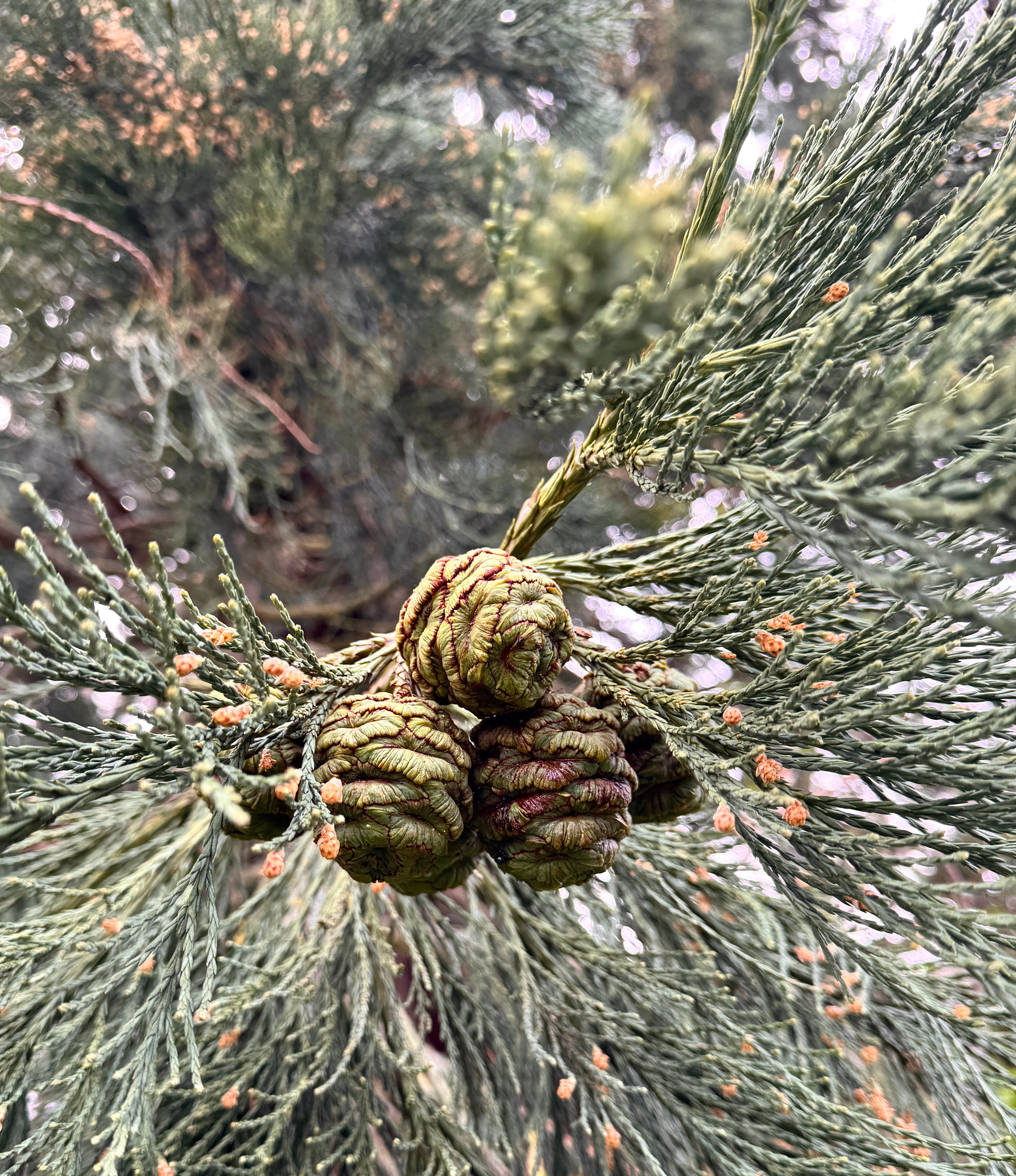
The small hive that I rescued last year, from what seemed like certain death at the time, I’m happy to say, has also survived the winter. This small colony, living over five wooden frames in a small poly box that I moved here after multiple swarming, much intransigence, wasp attacks and general pig-headedness that ultimately nearly led them to their total demise, (which I must say was entirely their fault and try as I might, they refused to bend to my will until what was almost the last minute). I am likely as stubborn as they, so ignored the general advice I was given by other keepers to leave them to their fate and walk away, but by the end of autumn last year I had faith they might have recovered enough to survive the winter, all packed tightly in their little box, wrapped with insulating tape, propped up at the rear at a jaunty angle to encourage any condensation to trickle forward and down to the exit rather than dripping like a cold shower onto their heads. They were crammed into their frames along with their Queen, closed up with a slab of insulation to fill the small gap between the top of the frames, wedged between the inside of the roof, then fed a small pouch of fondant, placed into a carefully cut hole in the middle of the foam board. The entrance block was set to minimal, and I left them in a sheltered corner of the garden, out of the wind and near to the vast misty clouds of early pollen from the vast Italian Cypress that stands nearby.
Over the four or so months of late autumn and winter, I opened them three times on the days when the sun was bright enough and the rain held off and the wind was still, briefly peering in through the gap in the insulation to gauge how much of their food they had eaten and if it needed replacing. They buzzed drowsily and crawled around the top of the frames in their box, the warm smell of honey and bees that only keepers will know rising from deep inside, and in those brief moments that I saw their golden and black bodies keeping each other warm in winter, I knew that my patience with them had paid off. My refusal to accept defeat had given them the chance to bring themselves through the cold months. I kept the roof off for no more than twenty seconds at most, counting out loud to myself, not wanting to chill them any more than I needed, whilst I checked their food levels, and muchlike the other colony, they have been completely unfazed by my presence. I have sat on my knees next to their entrance, my face inches away from the daily hubub, watching their doorway as the foragers pile in and out, the clutch of tiny guard bees that wait just inside the doorway with their almond shaped eyes and curious wiggly antenna seem completely unthreatened by my presence as they don’t venture out to send me away, they just sit inside their doorway inspecting the apiarian traffic, the comings and goings of the pollen laden bees leaving me completely alone to go about hive business.
For now, until early April, once a week for each hive, I shall lift the roof when the weather allows and look to see how much of the fondant pouches they’ve eaten. I will watch them closely as they fly in and out to look for any signs of disease: malformed wings, obvious signs of mites, bald spots on their soft, fuzzy bodies, and happily, the last time I checked, all seems well for now.
Kobujime, pickled rhubarb and cream cheese brownies (in no particular order)


I’ll end here today with my recipe for pickled rhubarb that goes very nicely with the kobujime of cod that I put away the other week that you can see here. Kobujime is a traditional technique from Japan that involves preserving fish using kombu, sake, white fish, patience and a little faith in your ingredients. I’ll share this method in my next essay.
To tempt you to subscribe, I’ve also included here a gratuitous photograph of a tray of warm, gooey vanilla and cream cheese brownies, straight from the oven, one crusty corner cut off to go nicely with my afternoon cup of tea.
The technique for the kobujime is straightforward and is one for the braver souls amongst us, the brownie is just sublime, no fuss and is best eaten with those that you love.
Both techniques will follow later this week.
In the meantime, find yourself some bright pink rhubarb and make yourself a jar of pickles.
Pickled Rhubarb - a simple technique
Firstly, you’ll need to find a clutch of thin stems of forced rhubarb, shockingly pink, tart and crisp.
Look in any fine greengrocer and if they dont have it in stock, demand it. It has a short season, which is at its peak right now; it is utterly delicious, it makes a fine dessert or compote if you can’t bring yourself to pickle it, and makes a very good cordial that you can add to good, strong gin if indeed that’s how life is going.
When you have found your supply of rhubarb, locate yourself a bottle of cider vinegar, a small piece of root ginger, a mug full of sugar and a good pinch of salt.
In a saucepan, pour around two hundred millilitres of vinegar, add one hundred grams of sugar and a little salt and bring to a simmer to dissolve the granules, then turn off the heat. Finely slice a thumb sized piece of ginger and add it to the pan. If specifics aren’t your thing with measurements, then go with the flow. It is quite forgiving.
In the meantime, wash the rhubarb and trim away any peculiar looking ends or bruises, then slice, (let us say) three hundred(ish) grams of the bright pink rhubarb stems into small equal pieces and tip them into a clean sterilised glass jar, then pour over the hot pickling liquid along with the ginger to near the brim of the jar, top with a small disc of waxed paper if you like to make things look neat and pretty, and then with a strong grip, twist the lid tightly closed and turn the jar upside down to cool.
This encourages the vacuum to form and also creates an interesting talking point for those of you who might like to show off your pickling brilliance to your friends.
Leave it for at least a week to develop its flavour and colour, then it is ready to use.
Until next time,
For now,
William
Sublime! Infrequency makes the words and images even more welcome. Less is indeed more. Cheers mate, and thanks from the colonies! 🖖
Reading about your bees and you surviving the winter was breathtaking. I used to keep bees in Illinois and could empathize with that battle of wills. Every hive is different! So much personality determined by the queens.
Thank you! And enjoy your spring!
Your photos were lovely by the way.