
Swarm
Spruce tips, collecting a wild swarm of bees, cordials and vinegar.

“We humans are a minority of giants stumbling around in a world of little things”.
Sue Hubbell, 1935
West Berkshire, May 2026
With the large influx of new subscribers this last week, I welcome you to my ramblings.
Mid afternoon
I had taken a moment or two for myself, quite simply to sit in the grass after sorting through the frames of both of our hives, a stifling hour spent zipped up in a multi layered suit that is bulky and warm complete with wellington boots to deter the young crawlers that are yet able to fly and that fall off the frames and land on the ground and have the propensity to climb up your leg and catch you off guard with a sharp sting to the ankle, and with my long yellow leather and cotton gauntlet gloves to complete the occasion, that cover my sleeves up to my elbows, wholly unlike the beekeepers of Instagram, who you see merrily pulling apart hives wearing T-shirts and shorts, for they are not simply brave, they are quite mad. As much as one becomes slightly accustomed to bee venom, I dont relish the chance of annoying a colony whose patience and sense of humour may have already been stretched that day, to suddenly snap and reward me for my efforts to assist in their lives with a trip to the hospital swollen up like a balloon.
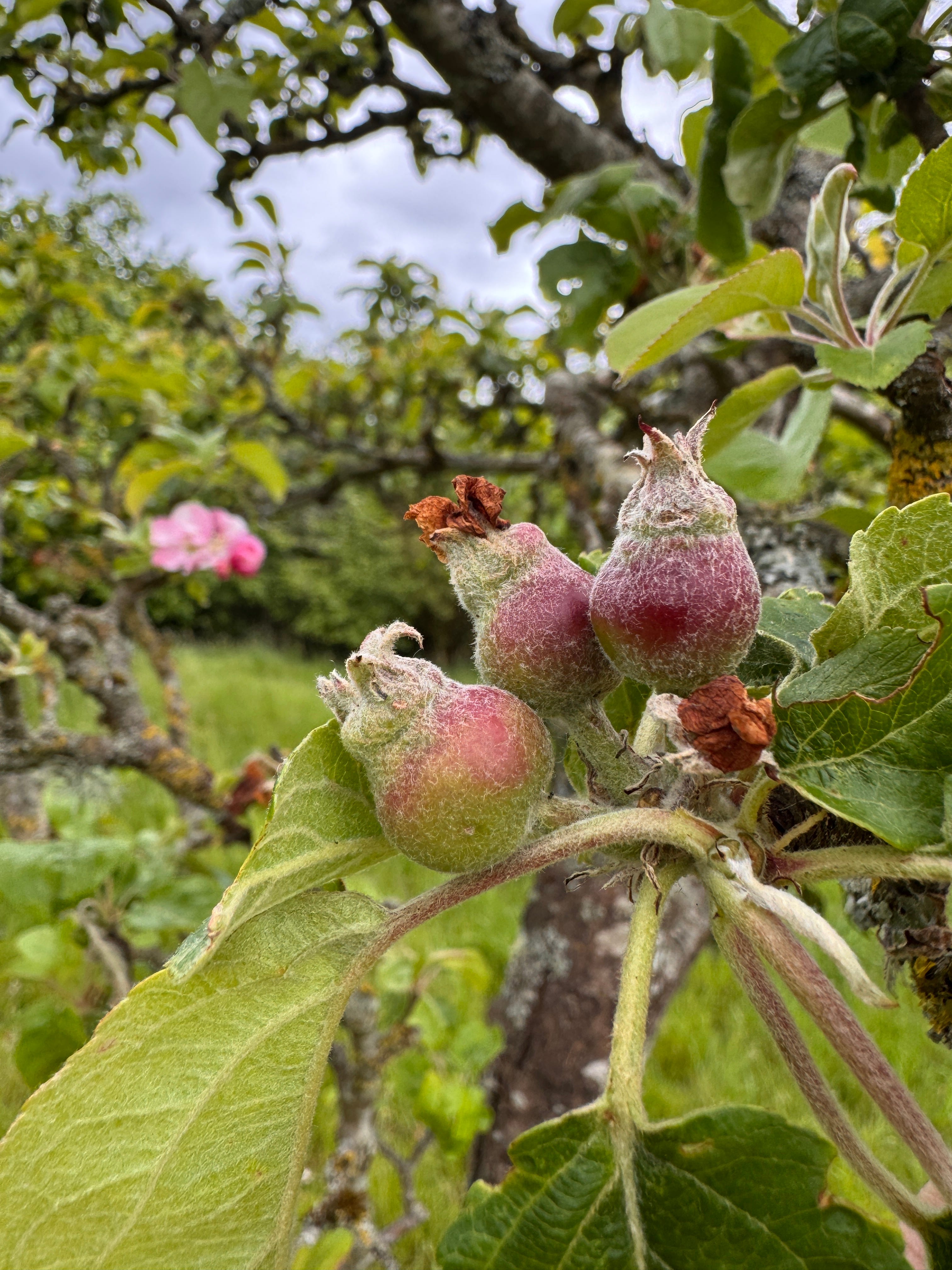
I had taken a moment in which in to lay back with my face to the sunshine, deep amongst the clover and vetch on the newly mown path that leads through the long swaying, heavy headed grasses that now reach my knees, as I’m stretched out in the sunshine in my thick beekeeper’s suit, zipped up into woven layers of mesh to protect me from any incivility from the girls that I do my level best to care for.
Reclined in the grass for a moment or two, to soak up the breeze and the sun, after hefting heavy boxes of bees, dripping with pale liquid nectar that sticks to the toes of my shoes, hives filled with brood and frames of waxy, capped honey, as I work my way through the boxes, as I inspect each part of the hives. I sit low down on the ground amongst the mosses and the small, pointed, long coat-tailed leaves of bright verdant sorrel that sit amidst tiny racemes of the powder blue forget-me-nots along with intrepid black spiders and curious black beetles, armour clad scuttlebuts with their terrifying mandibles, minding their own business whilst I prod at them with curious fingers, watching them intently as they clamber over the woven dense stalks of the meadow as they go on their way.
Meadows
The deep green tightly furled clusters of the tips of the buds that wave at the top of the long stalks of Cocksfoot and Crested Dogstail, tall as they stand, moving softly like long ballerinas as the soft wind moves through the blades of the wild grass with invisible fingers. As I watched the ornate wings of the bees as they flew in and out of their entrance, tumbling and bouncing off one another as they jostled on the ramp to clamber into their hive. I can often sit and watch them for what seems like hours, sat close to their world in a box, feeling mostly unthreatened as over the years I have learned to read their behaviour and trust in my judgement. Common Vetch catches my eye as it nestles in amongst the Creeping Jenny, Oxlip and Red Campion that grow in the overgrown edges under the branches of Hazel that steady themselves against the tumbledown brickwork of an ancient, overgrown wall.
I can smell the thunderstorm as it draws in; in the warm afternoon, the air feels charged as the pressure builds high above in the immensity of the majestic procession of the brilliant white and lead grey cumulonimbus that gather and wander across the sky ominously toward the east of the treeline. A lofty walnut tree with its beckoning limbs that looks most worthy of a climb, though today I’ll not brave it out of respect for my knees and for fear of an unglamorous exit strategy, now shows its newly sprouted leaves, as the last time I came here, it stood silently guarded behind its dowdy old bark at the edge of a thicket of bramble. A place in the woods where the deer meet your gaze, and a quiet corner of England where the first page of my book takes shape.
The walnut reaches upwards with its arms of rough bark, and as the month of May ticks by, I know that soon will be St John’s day and time to collect its haul of mottled green and black-skinned tannic fruits, that I’ll shake from the limbs and preserve with warm spices in glass jars of sweetened malt vinegar. Piercing the walnuts with a long needle to confirm that their shell has not started to form inside; fingers and table stained a deep blackish yellow from the juglone inside the nuts. And then I can think about opening the Nocelo and jars of dark pickles that I made last summer that have sat undisturbed for a year.
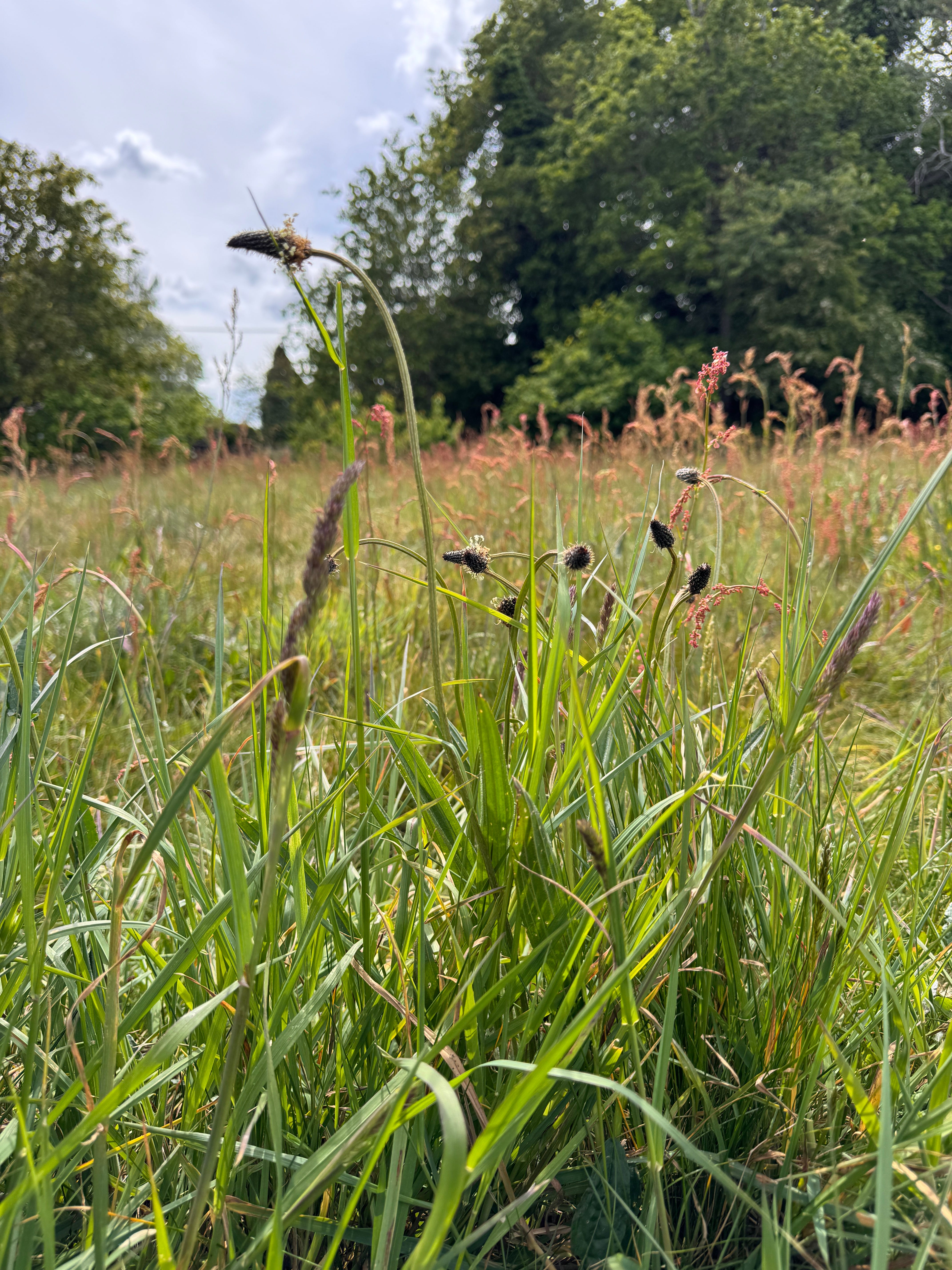
Lost in a day dream of wild flowers and walnuts, of bees and the staccato metronome of the woodpecker’s work that bursts out from the copse at the top of the hill, and here, warm in the sun despite the menacing weather that gathers above me and as I sit here I feel my head loll to one side, snapped to with a jerk that tells me I need to stand up or fall victim to the somnolence of the late afternoon.
Swarm
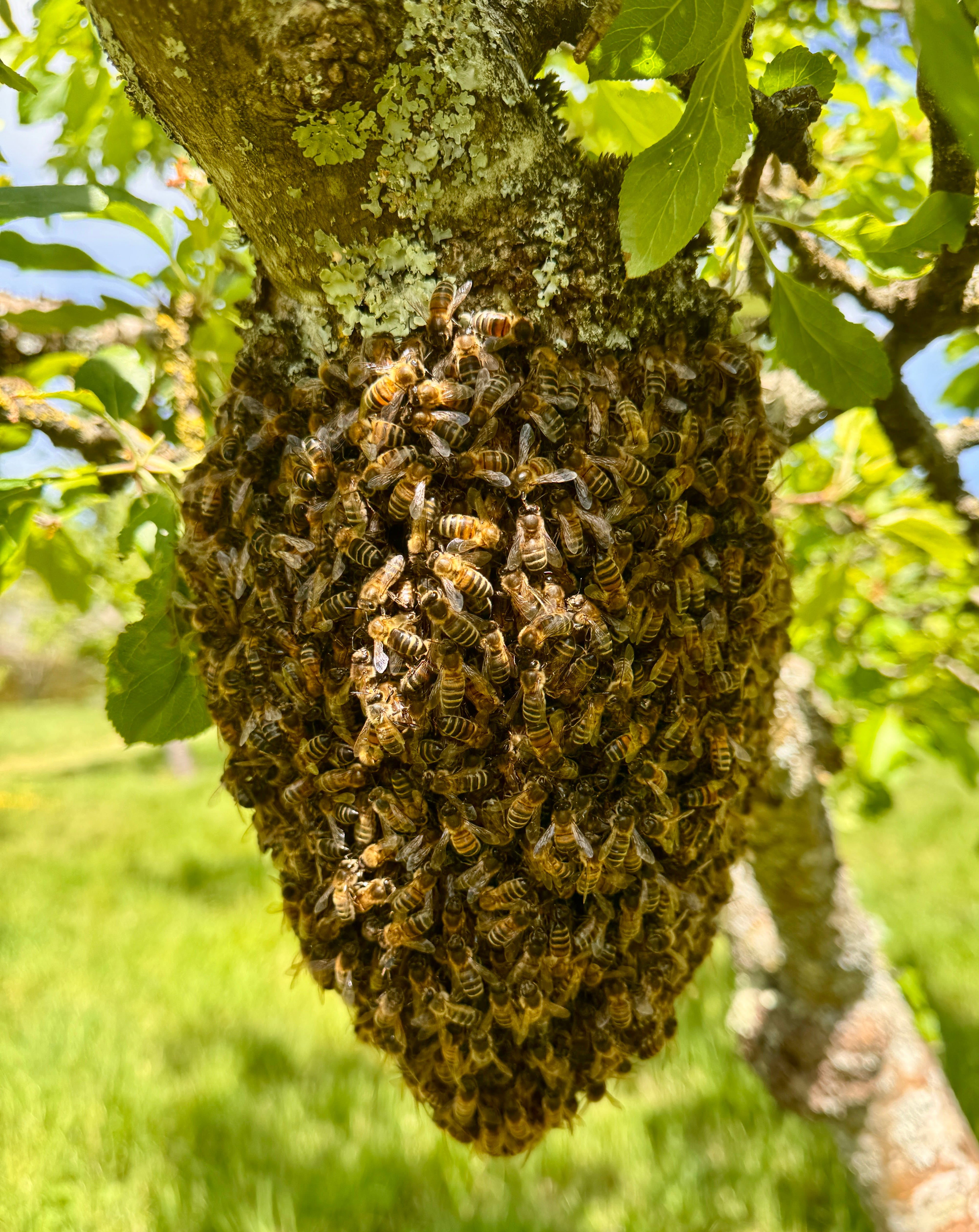
As I sit up, I’m drawn to a shape that is hanging from a branch a few paces from my place in the grass. My focus is on an oddly shaped cluster at the end of a branch of an apple tree. What took me a second or so to recognise was a cluster of bees.
A swarm.
A fat pulsating swarm of lazy young bees, stuffed full of honey, gathered in the shape of a rugby ball with their queen at the centre of the mass of small insects that hangs from the branch of the tree. Quite an inopportune time to have swarmed with the weather, feeling as if the thunder might crack at any moment. And from where they came, I have no idea, as I imagine within the few miles of this place, there must be dozens of hives.
We are truly in swarm season at this point in the year, and our local beekeepers’ association has said that so far, this has been the year of the swarm. Multiple swarms from almost every keeper in the county since April, and the local public has been reporting at least three swarms each day for us keepers to collect this month.
A time when bees from truly strong colonies have the confidence to take a chance on themselves and their queen, and will decide to go it alone, so happy they are with their world. Swarm is a word that, for me, is misunderstood, a word that invites fear and misapprehension. Swarming is part of the beekeeping calendar for every keeper, quite simply an act to remind us that the creatures we help are truly wild.
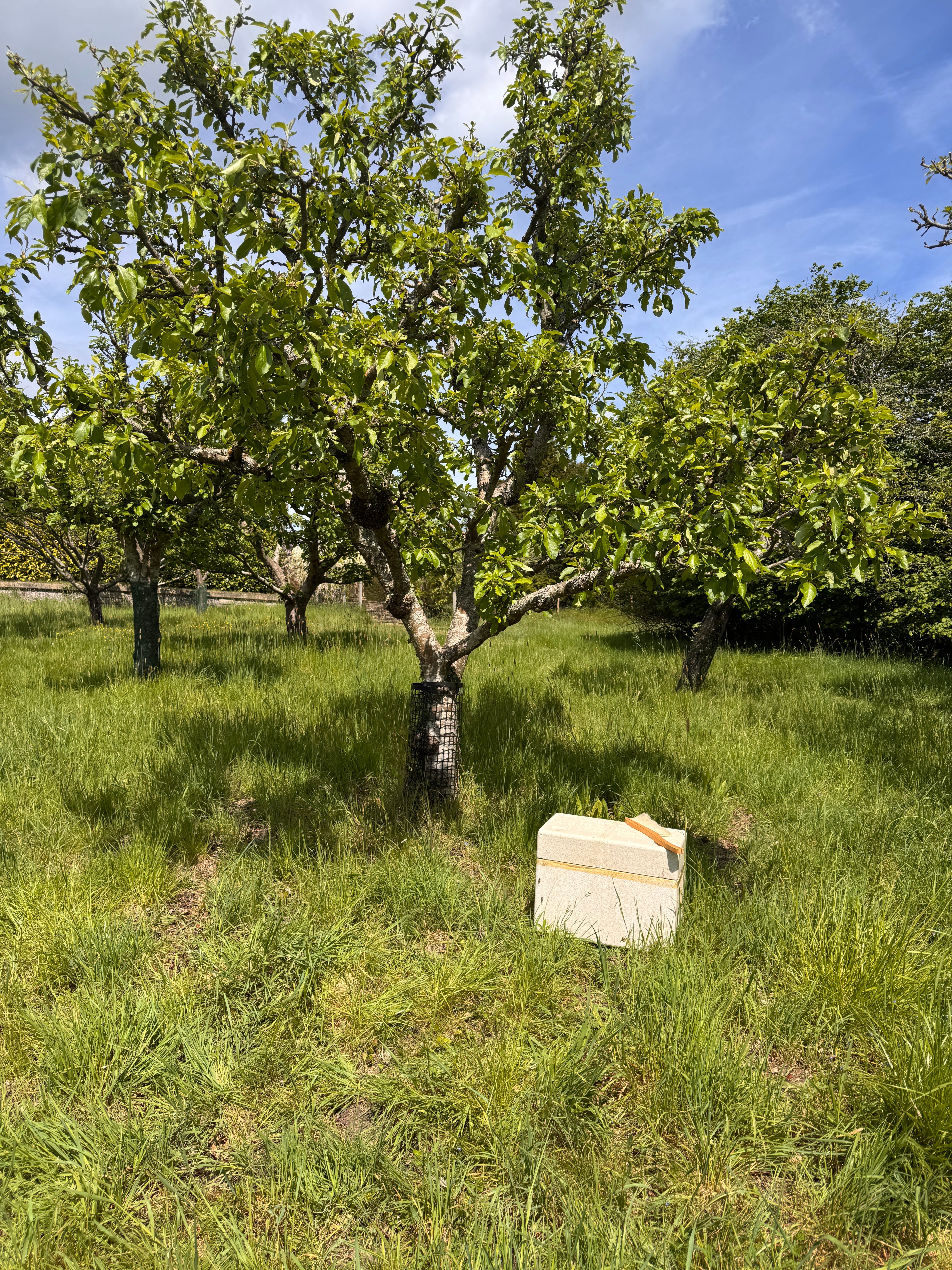
And not having collected a swarm before in these four years that I’ve kept bees, and what with me sitting next to the few thousand or so headstrong insects, balanced in a great fuzzy lump, hanging from the bough of a tree, I decided that as someone who has a responsibility toward two colonies, it would be remiss of me to leave them to travel again in search of a home, and as I like to face a challenge head on, I stood up and walked back up to the house to collect the spare, empty nucleus hive that I’d stored away after transferring the colony last week. I picked up my bee brush, the hive box with its lid, and my smoker, a device that usually fails to keep alight whenever smoke is required, letting me down at precisely the moment I usually need it, and that I always keep charged with a plug made of cardboard, straw and broken old pine cones that just needs to be lit at the base, then pushed into the chamber and closed, squeezing the bellows with gentle puffs to encourage the cinders to catch and allow the cool fingers of wispy grey smoke to twist upwards from the spout.
Something nice for you for being here…
As May is a month that usually cheers me up, what with it being a month when the sun comes out, it is also my birthday, lilacs are in bloom, it’s asparagus season and all manner of other nice things, and with that in mind, here is an offer for you.
50% Off all new subscriptions, valid for one year, for the whole month of May
“What’s the worst that might happen”? I said to myself at least a dozen times as I walked back to the trees.
I was wearing my bee suit, so in principle, if indeed my foray into coaxing small wild insects that have a propensity to sting when alarmed into a polystyrene box were to fail miserably, I should be completely fine. The suit is expensive and bulky, and with that comes a certain certainty that as long as you’ve toggled the zips correctly (ahem), you should be just fine. It is said by a fellow keeper that you could (if you so wished) wear nothing but your underwear beneath it and still not get stung, and I don’t know if he has tried such folly, but that’s not something I’m prepared to do.
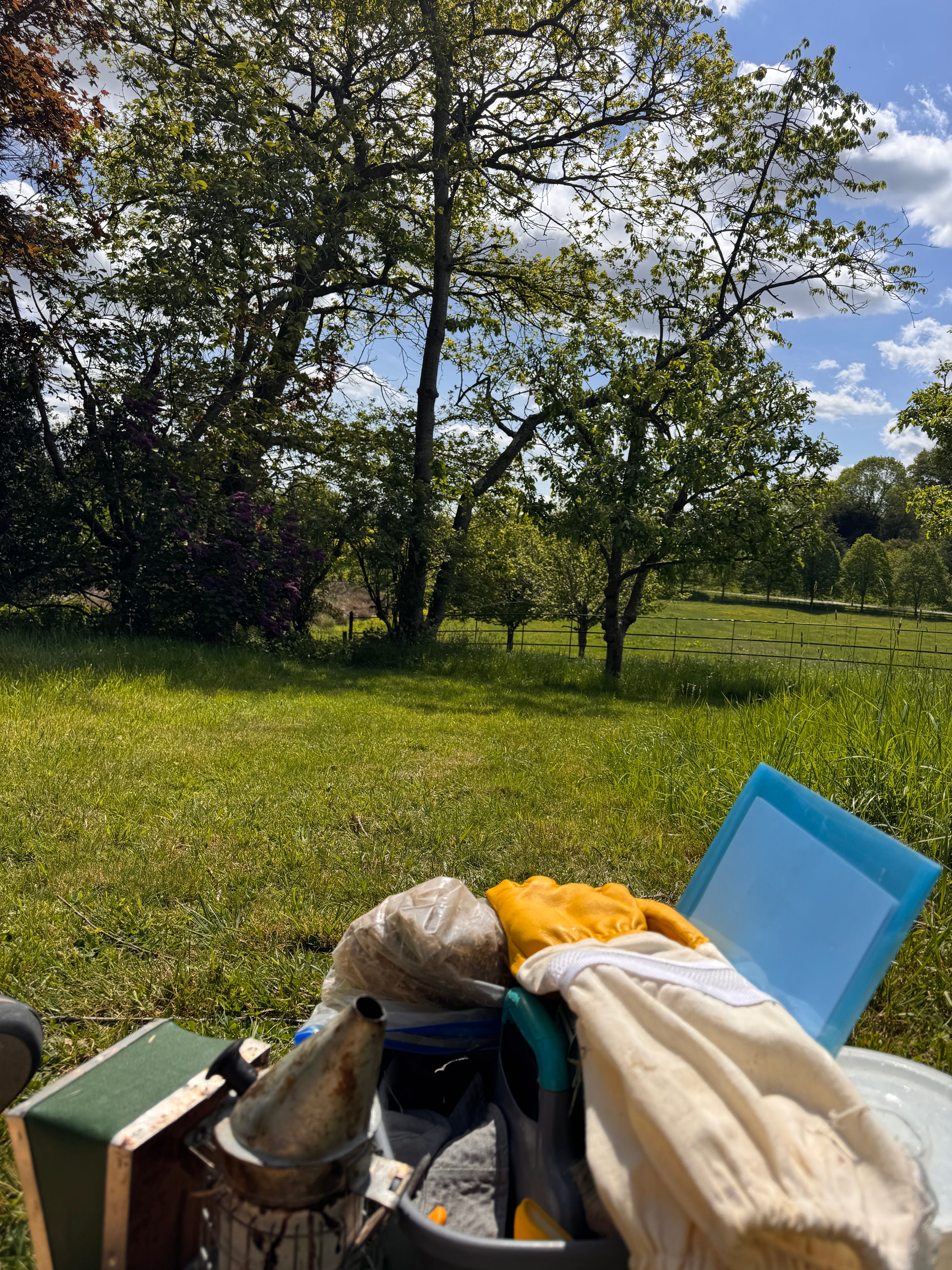
Approaching the hypnotic mass of bees, hanging from their adopted branch, gorged on honey, docile and therefore unlikely to be bothered enough to pay me any attention at all, I took the lid off the box and lifted it just underneath the cluster. With my wooden handled brush with long, soft bristles, in one movement that I’d not had to perform before, I swept them downwards in one swift movement, dropping the whole mass of stripy insects into the bottom of the box with a resoundingly soft ‘thunk’.
I had collected my first swarm.
In a box.
Next, I asked myself, what on earth should I do with it?
Heavenly things- Cordials and vinegars
Elderflowers are still not quite there, though with some of the bushes full of the dusty white heads, there are many that still are tightly closed. There’s also an overgrown bush with pink blooms that I think tastes the same, that stands on a remote track near the bottom of the hill, up where the woodland of two hundred truffle oaks was planted some years back. A woodland of secrets that will stand for centuries up on the ridge where the deer graze on sloes and wild apples and where, at the edge of the meadow, the banks of wild garlic have turned into flower heads with their small capers inside the blooms, which I’ll collect and then pick off with a fork and pickle in vinegar.
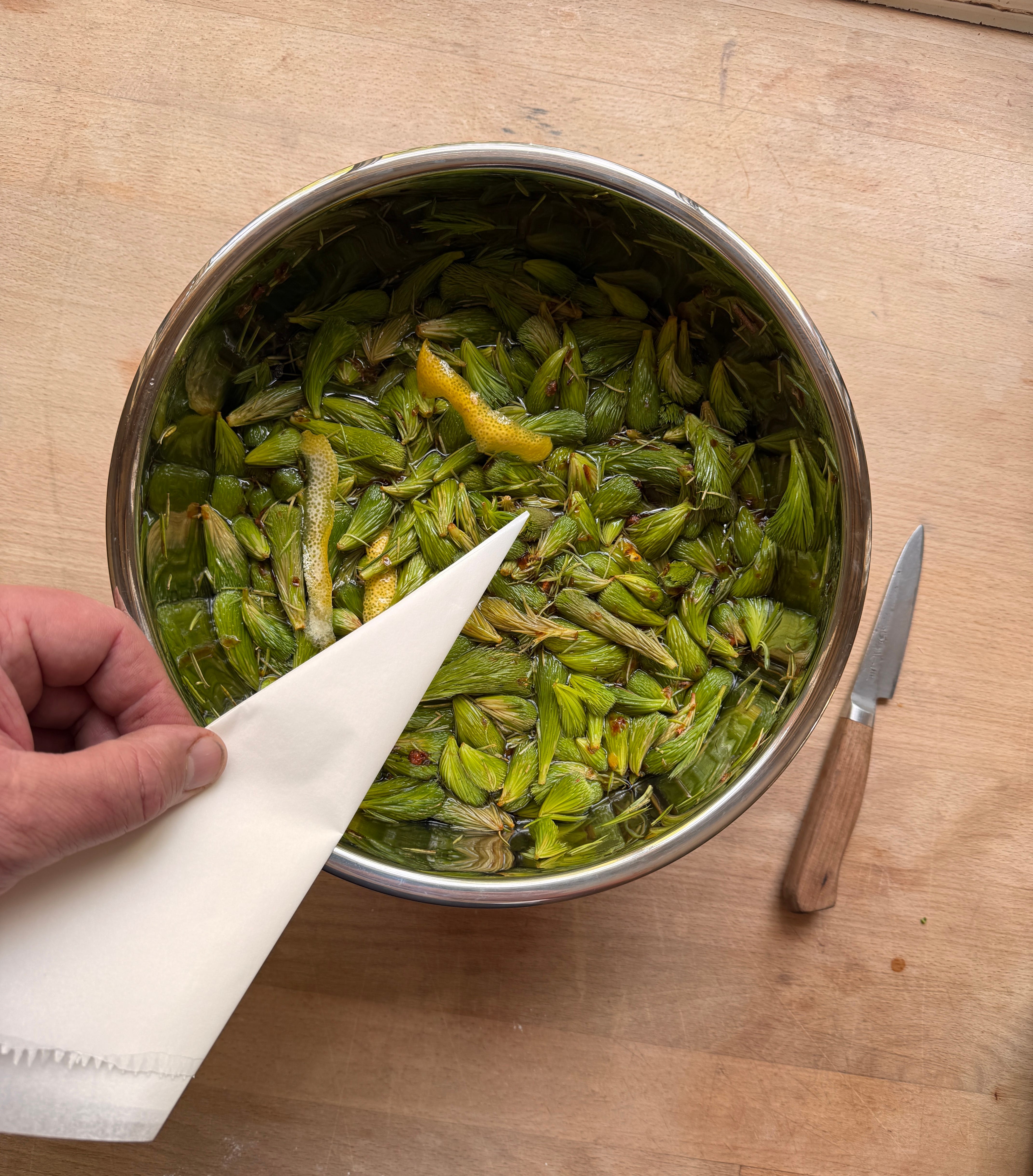
With a bowl full of spruce tips collected from the woods, I set my mind to the preparation of cordials and vinegars once again. I pick out a furled tip of the spruce and bite into its feathery structure, releasing the sharp citrus burst with its mild notes of balsam. Most certainly not for regular eating, as I spit out the mass of fine spruce needles that have coated the inside of my mouth.
I make a pot full of thick sugar syrup, and when it has mostly cooled, I tip in half of the washed soft green tips along with thin strips of peel from a couple of lemons, stirring the spruce tips into the resinous liquid. I pour everything into a large metal bowl and neatly fold a paper cartouche, tearing it off and placing it on top of the syrup to then sit overnight on the bench, then into the fridge, before somewhere this week, straining the mass of soft needles, discarding the waste and then bottling the flavour of forests.
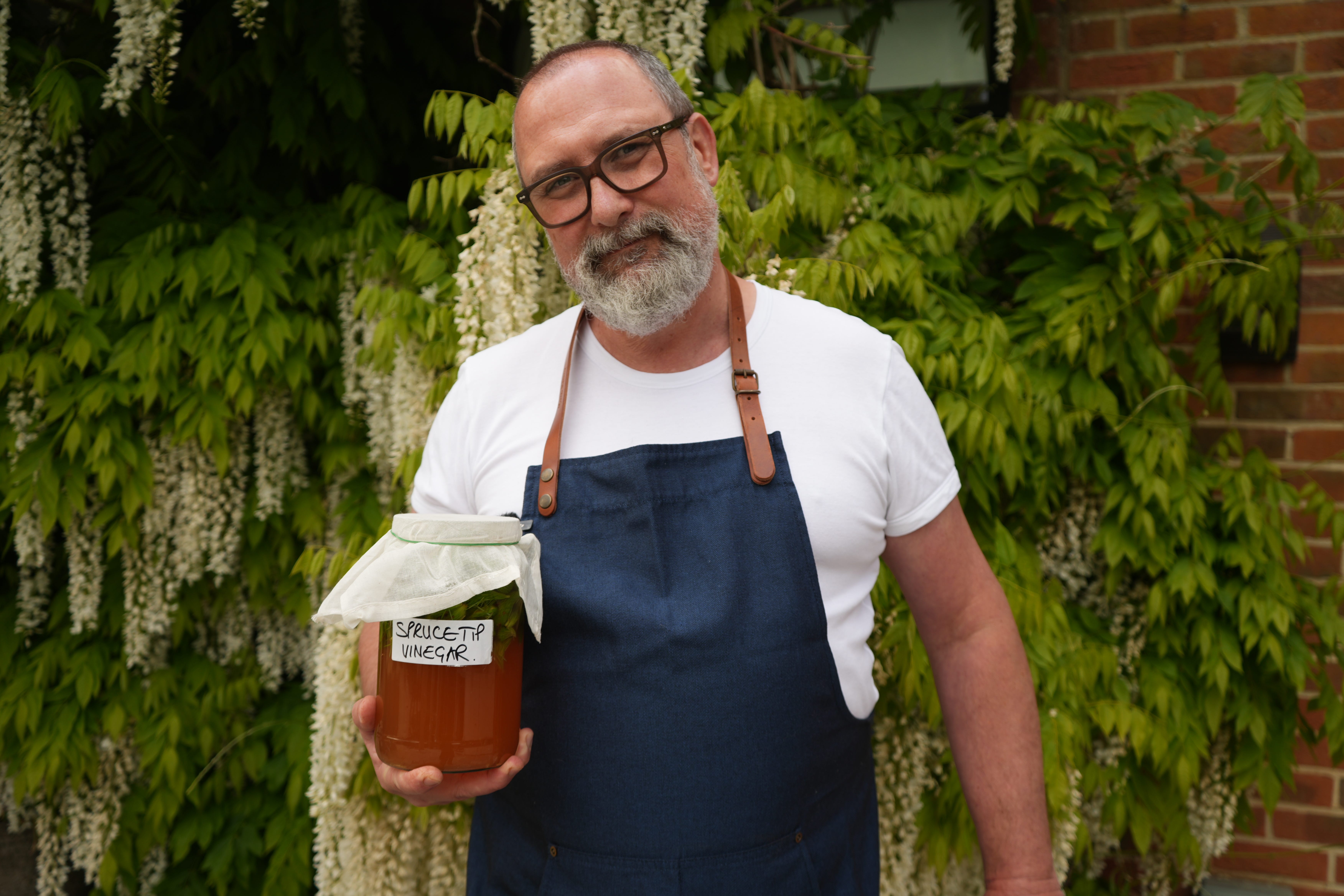
With the rest of the tips that I collected in need of a purpose, I walk to the shed where, up on a shelf, sit a row of large plastic vessels, filled to various levels with well over one hundred litres of raw apple vinegar that came to life at the end of 2023. What began as two hundred or so litres of young, vibrant juice, fermented into cider, was then aerated over a year with the addition of a vinegar mother that I’d previously grown and allowed to slowly turn into acetic acid. The result after the years of patience is a blushed golden vinegar that is the base of much of the food that I make. I have bottles and jars filled with aromatics and fruit that we grow, or I find in the woodlands and hedgerows. Rosehip, plum, blackcurrant leaf, dill seed and fennel twigs all sit submerged in bottles for dressings or deglazing pans as they come out of the oven.
Spruce tip vinegar is another to add to the assembly that sits in the dark in the cellar.
I half fill two jars with the remaining tips and then slosh in the sparkly bright vinegar to cover them up to the brim, then with messy fingers, pick up a gloop of the mother and drop a little of the cellulose gloop into each jar. I place a square of muslin cloth over the top and secure it in place with a band. They then go to the cellar to join the other pots, jars and bottles at one end of the row on the top shelf of interesting things that I’ve made.
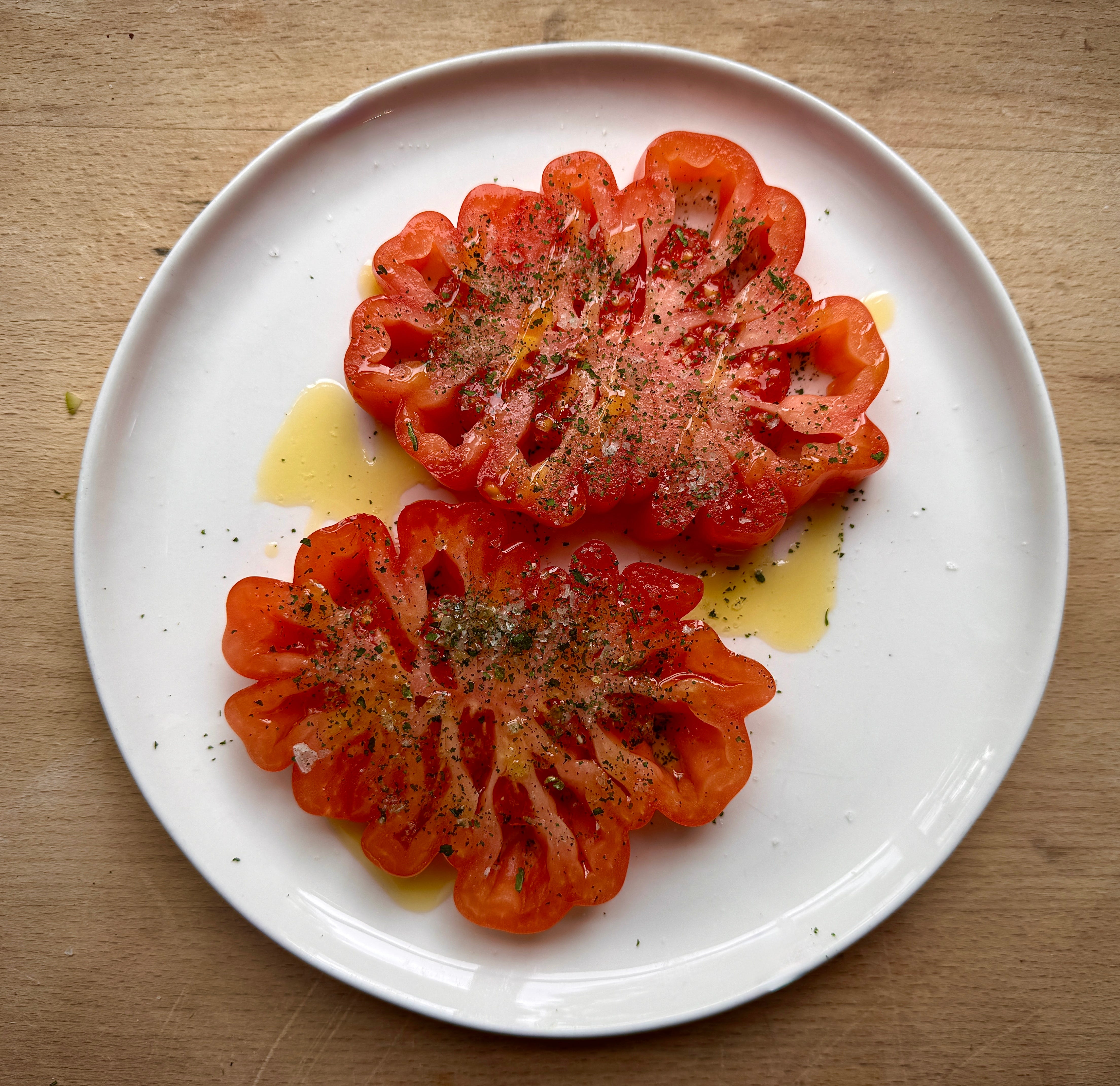
And with the arrival of great big tomatoes that I slice into ungainly slices and sprinkle with little more than a big pinch of wild garlic salt and a good splash of oil, the world is a happier place.
William
You don’t half leave us in suspense about your swarm! I suppose I must be patient.
Dear Will, thank you for inviting us into your special world, an England that still exists when seen and recounted by a gentle wizard, and one that makes magic potions to share. Bravo for the Bee swarm! Kate